Soybean Looper Defoliation Guide
Authors: Igor Sulzbacher Schardong (NC State University), Dominic D. Reisig (NC State University), Berenice Romero (Louisiana State University), Jeff Davis, (Louisiana State University)
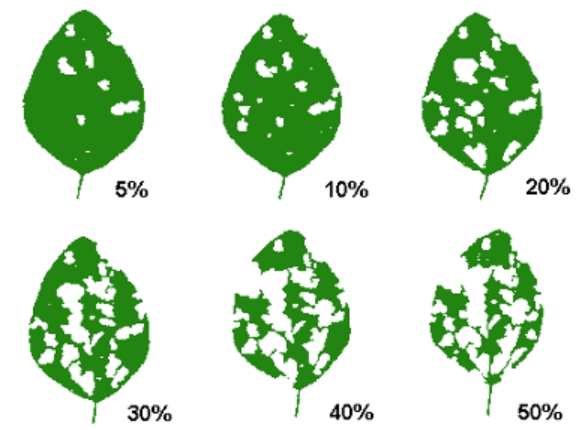
This tool is coupled with recent changes that we have made to soybean defoliation thresholds.
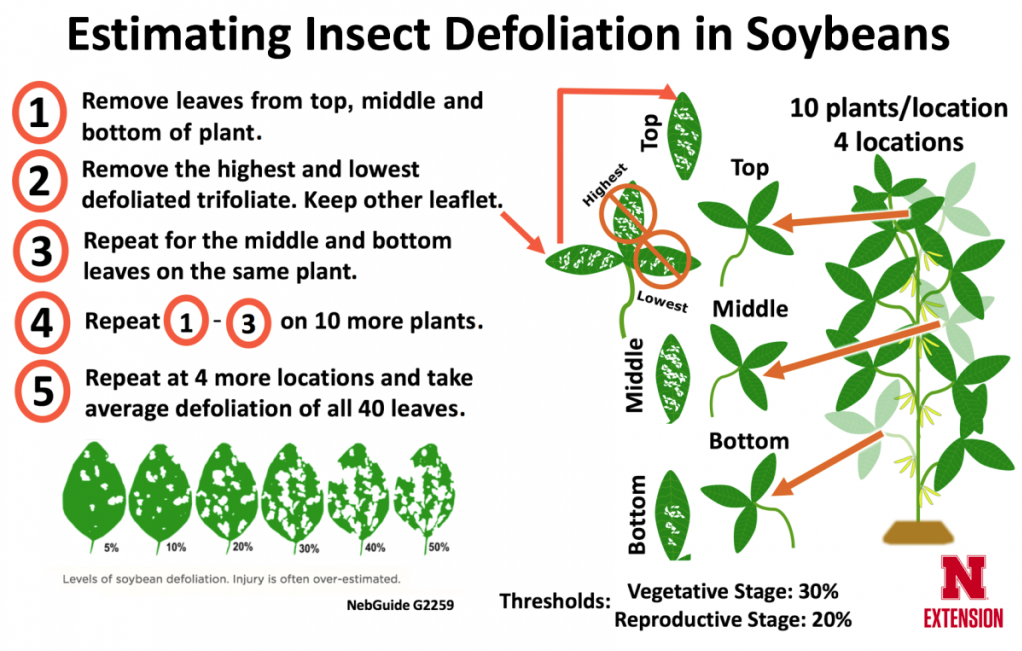
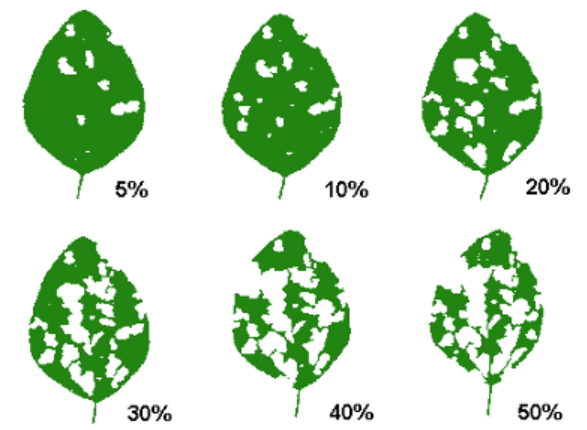
After bloom: 25% of the canopy- full-season soybean (planted prior to June 1)
Defoliation thresholds will remain the same in vegetative growth stages and for reproductive stages in double crop beans
Vegetative Growth Stages: 30% of the canopy- for both full-season soybean (planted prior to June 1) and double-cropped soybean (planted after May 31)
After bloom: 15% of the canopy- double-cropped soybean (planted after May 31)
Soybean loopers can be tricky pests. One of those reasons is our that our defoliation thresholds (the level of leaf loss when we say it’s time to spray) let the caterpillars grow. Loopers do most of their feeding damage in the last few days before they turn into moths. That’s when they’re biggest and when they are harder to kill with insecticides.
If you wait until loopers hit the threshold, you may also be letting them grow larger and more damaging. That’s why it’s important to 1) keep defoliation under the threshold, 2) watch how many loopers are in the field, 3) check their size, and 4) estimate how much more they might eat.
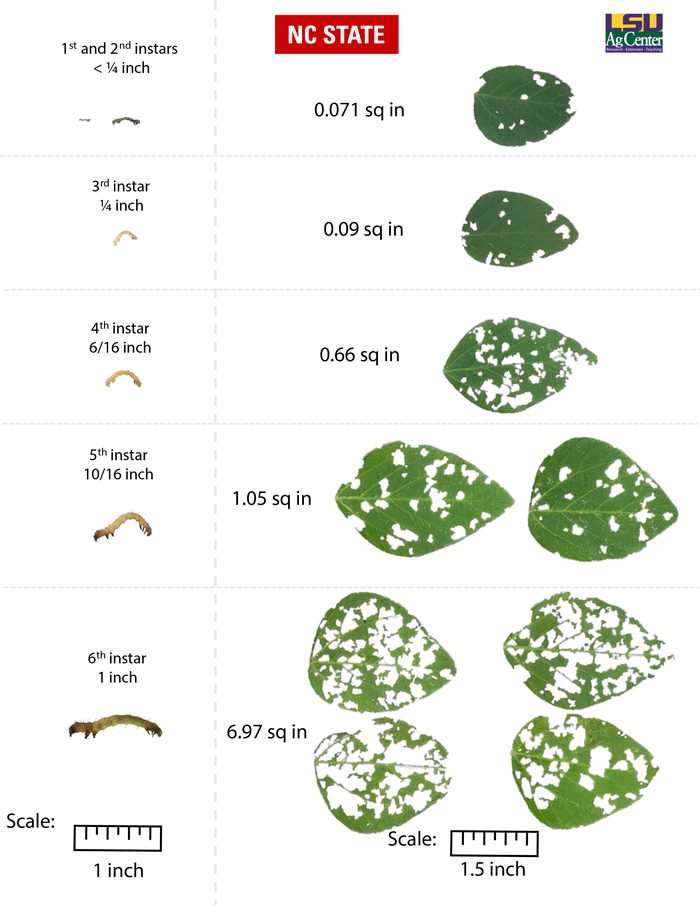
We put together a guide using both published research and our own data. It shows how big soybean loopers are at each stage (called “instars”, with a 1-inch scale to compare). It also shows how much leaf tissue they eat as they grow (with a 1.5-inch leaf scale).
We found that the smallest loopers (1st and 2nd instars) eat very little, less than 1/10 of an inch of a leaf. However, one large 6th instar looper can eat almost 7 inches of leaf tissue.
When you scout, don’t just look at how much damage has already happened. Also look at how many loopers you see and how big they are. A few big loopers can do a lot of damage fast. That can help you make better decisions and avoid surprises.
Corn Earworm Thresholds
Use the online corn earworm in soybean
threshold calculator, and visit the
corn earworm soybean pest page for updated information.
Example:
Assuming soybean market price of $10/bu
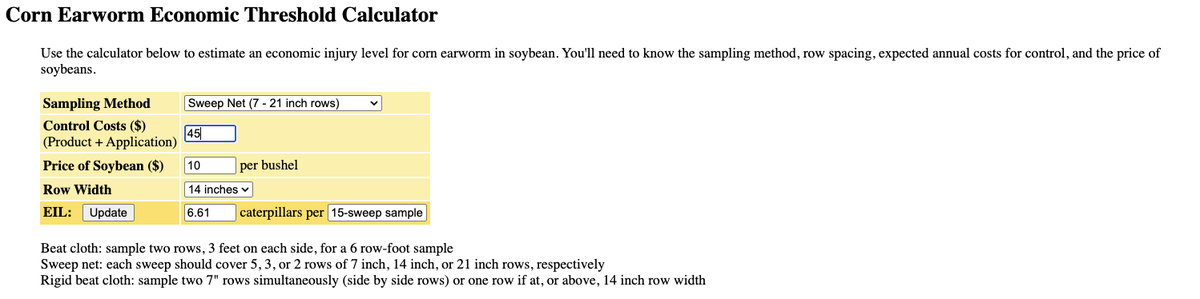
Control Costs: $12/ac drone/airplane application, Insecticide (bifenthrin + Intrepid Edge) + Fungicide = $33/ac - $45 total
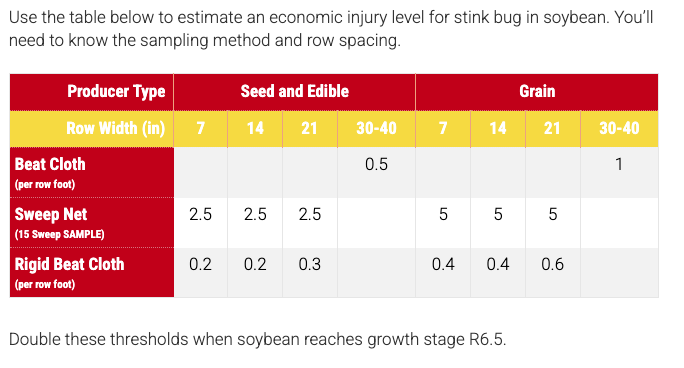
14" Row spacing - Threshold per 15 sweeps = 6.61 corn earworms
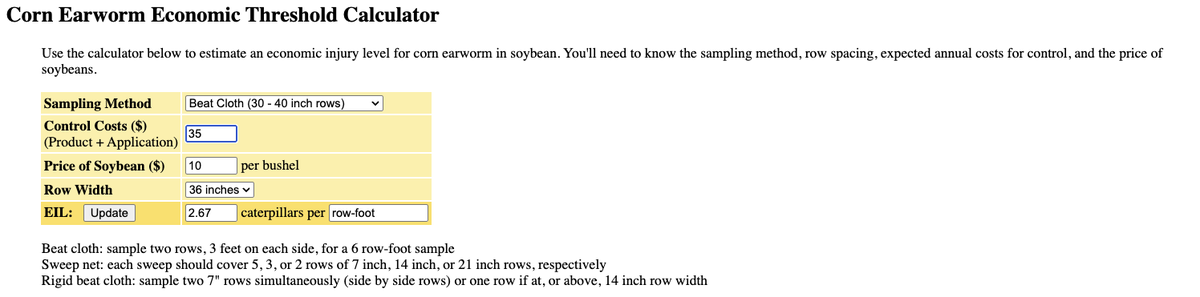
36" row spacing - Cost of control $35/ac - using beat cloth, threshold = 2.67 corn earworms per row-foot
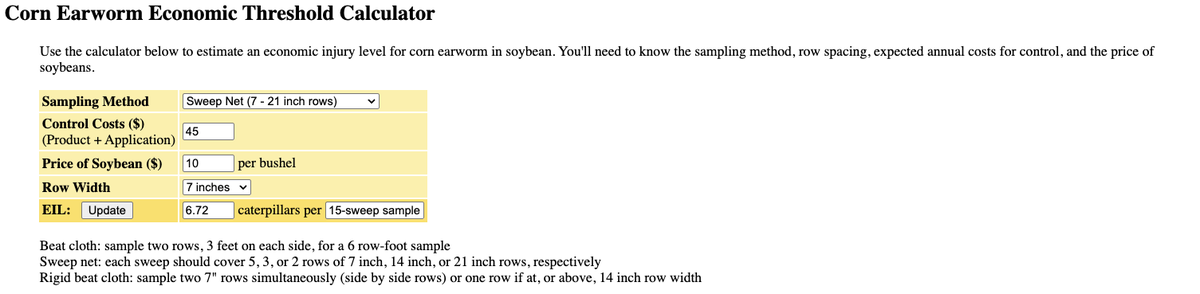
7.5" row spacing - Cost of control $45/ac - Threshold per 15 sweeps = 6.72 corn earworms
Make sure to use the threshold calculator to plug in your specific details to determine an accurate threshold.
Should I Use a Fungicide?
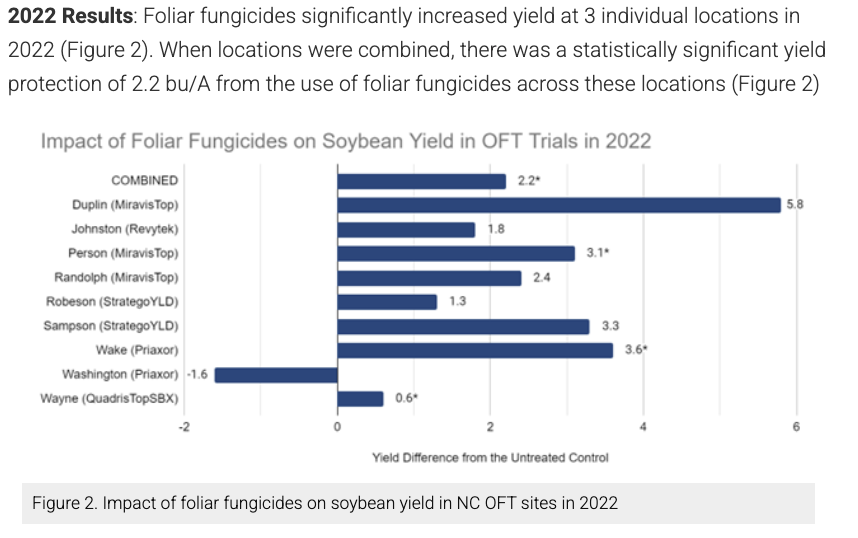
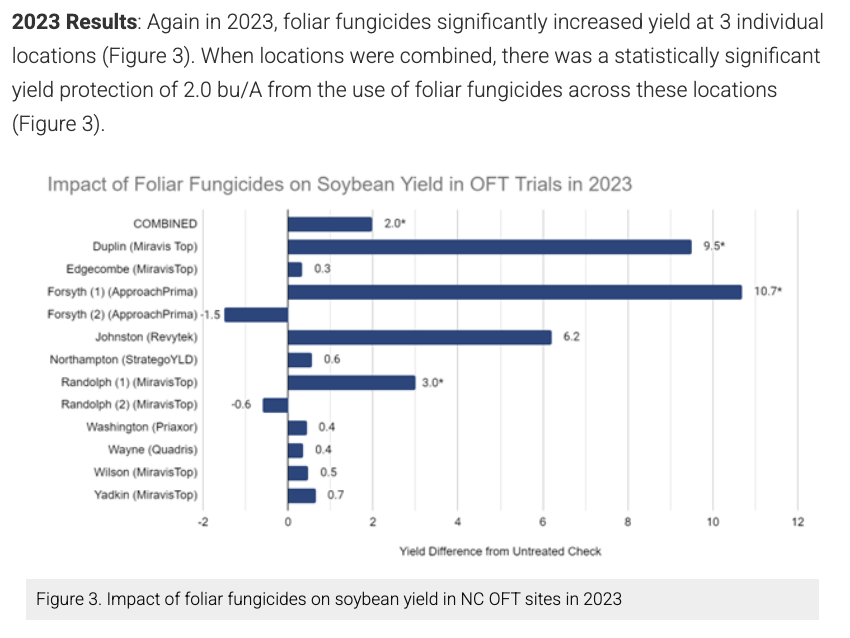
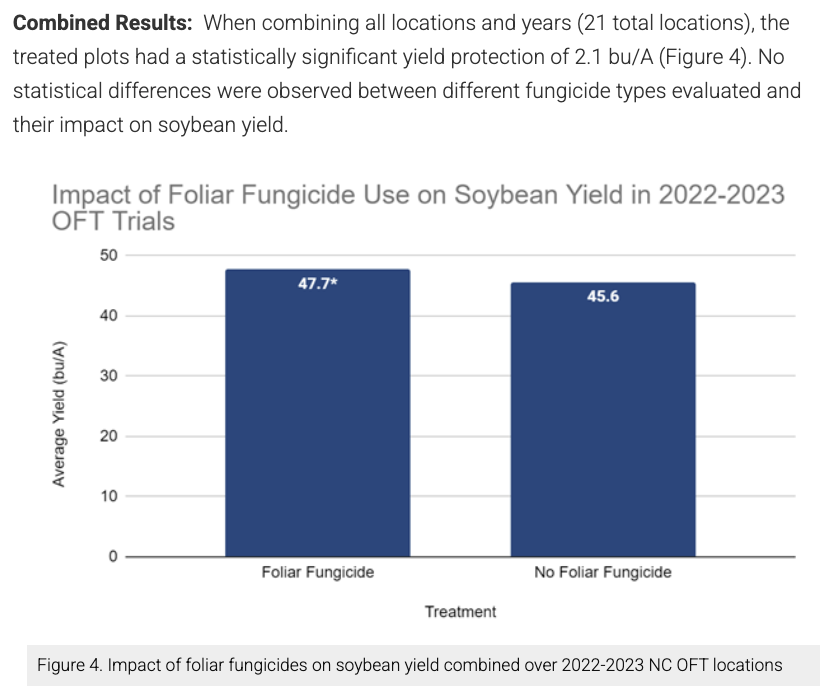
See data below from:
Soybean On-Farm Trial Results: Foliar Fungicide UseThe optimal growth stage for applying fungicides to soybeans for foliar disease management is generally the R3 growth stage (beginning pod). This is when at least one pod on the plant is 3/16 of an inch long at one of the four uppermost nodes. Applying at R3 helps protect the developing pods and maximizes yield potential by preventing diseases like frog eye leaf spot, septoria brown spot, and gray leaf spot. Make sure to consider the environmental conditions, disease pressure, and your soybean variety disease resistance when determining if a fungicide is needed.
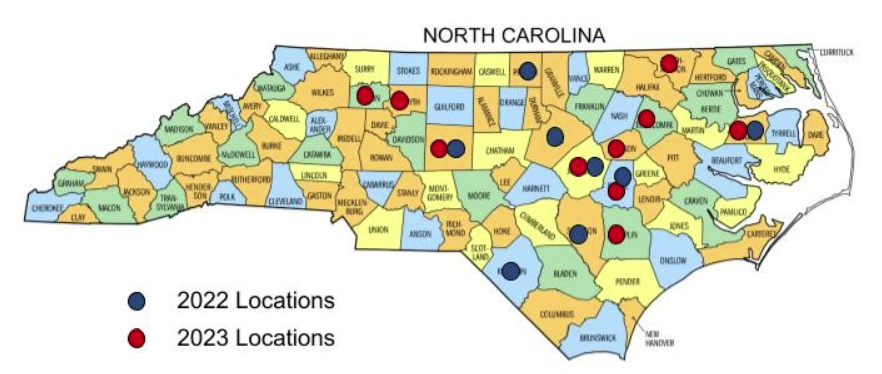
2022 & 2023 NC Soybean OFT Results
Overall, these results indicate that on average the use of foliar fungicides protect soybean yield by 2 bu/A. The environmental impacts (i.e. weather) and disease presence can impact the level of yield protection seen, but generally there is a positive yield impact when foliar fungicides are used. The data to support this claim came from 14 different counties over two years, providing a strong representation of North Carolina, and compliment both small-plot and producer-derived data from the NC State Soybean Extension Program indicating that foliar fungicides consistently impact soybean yield in the state when diseases are present and susceptible to moderately susceptible varieties to frog eye leaf spot are used.